The regulatory landscape for digital assets is shifting faster than ever. On Friday, March 27, Cactus Custody and leading law firm Drew & Napier LLC convened in Singapore to co-host an exclusive, close-door seminar for banking executives, legal professionals, and compliance leaders.
Our mission? To decode the highly anticipated 2026 FATF Targeted Report on Stablecoins and Unhosted Wallets and translate its global standards into actionable strategies for Virtual Asset Service Providers (VASPs) operating in Singapore and beyond.
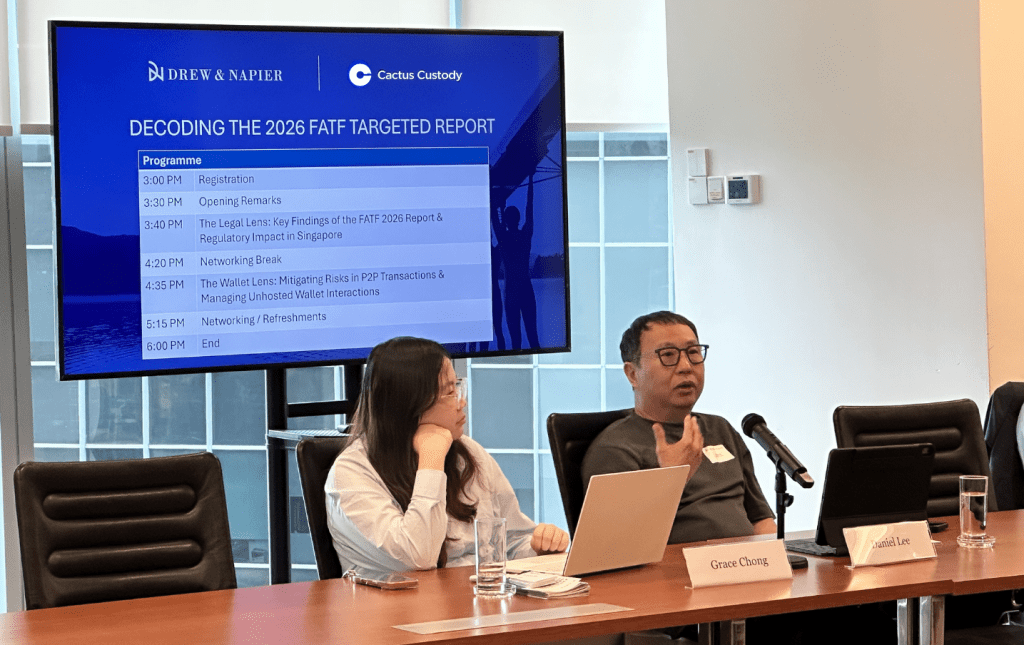
With a room full of industry veterans from leading financial institutions like DBS and Goldman Sachs, the dialogue was dynamic, bridging the gap between rigorous legal theory and practical, institutional-grade custody operations. Here is a recap of the key themes and takeaways from the afternoon.
1. The Volume Shift: Stablecoins Under the Microscope
One of the most pressing topics of the day was the FATF’s finding regarding the overwhelming dominance of stablecoins in illicit virtual asset volumes.
During the legal briefing, Grace Chong from Drew & Napier highlighted how regulators are responding to this trend. The shift away from volatile cryptocurrencies toward stable fiat-pegged assets by bad actors means that issuers and custodians must implement far more rigorous monitoring frameworks. The consensus in the room was clear: generic transaction monitoring is no longer sufficient; firms need deep, asset-specific risk intelligence to stay compliant.
2. Closing the “P2P Gap” and Unhosted Wallets
The “Unhosted Wallet” loophole was the focal point of our fireside chat. Because Peer-to-Peer (P2P) transactions bypass regulated intermediaries, they present a unique blind spot for global AML/CFT efforts.
Daniel Lee from Cactus Custody outlined the operational challenges and solutions for VASPs interacting with unhosted wallets. Key discussion points included:
- Enhanced Due Diligence: The necessity of proving first-party ownership of unhosted wallets before facilitating transfers.
- Chain-Hopping: How bad actors utilize cross-chain bridges to obscure transaction trails, and the “Good Practices” VASPs must adopt to trace these complex movements.
- Risk-Based Limits: Implementing dynamic transaction limits and automated holds when interacting with unknown, self-custodied addresses.
3. Programmable Controls: The Future of Custody Compliance
A major takeaway from the session was that legal compliance cannot exist in a vacuum—it must be hardcoded into a firm’s operational infrastructure.
Speakers discussed how next-generation custodial infrastructure is essential for meeting the FATF’s evolving standards. Programmable controls—such as smart contract-level freezing, dynamic deny-listing, and automated pre-transaction risk scoring—were highlighted as vital tools. By integrating these controls directly into custody workflows, institutions can ensure that compliance is proactive rather than reactive.
Looking Ahead
As Singapore continues to solidify its position as a premier, well-regulated digital asset hub, the collaboration between legal experts and technology providers has never been more critical. The 2026 FATF Targeted Report is not just a warning; it is a blueprint for the future of digital finance. Institutions that proactively upgrade their compliance and custody frameworks today will be the market leaders of tomorrow.
We extend our deepest gratitude to our co-hosts, Drew & Napier LLC, for sharing their invaluable legal insights and hosting us in their beautiful space. Thank you as well to all the attendees whose sharp questions and active participation made the event a resounding success.
At Cactus Custody, we are committed to providing secure, transparent, and compliant institutional custody solutions that adapt to the speed of regulation. To learn more about how we can help safeguard your digital asset operations, visit our website or reach out to our team today.