
The relentless drive for innovation to facilitate faster and more efficient financial transactions among modern users via blockchain technology has finally borne fruit. Introducing blockchain rollups: ingenious protocols set to transform the field by improving transaction speeds and reducing costs.
Blockchain rollups gather a group of transactions and consolidate them into a single unit of data. This aggregated data is then sent to the mainnet1 for processing. Since rollups handle the data off-chain2, they are often referred to as ‘off-chain scaling solutions’. Rollups alleviate the load on the mainnet by taking transactions off-chain for processing before compressing them into a single data entity that is subsequently reintegrated into the mainnet.
Unveiling Two Types of Blockchain Rollups
Currently, two primary types of rollups dominate the landscape – optimistic rollups and zero-knowledge rollups, often abbreviated as zk-rollups. These variants bring distinct approaches to the table, each with its advantages and mechanisms.
| Zero-knowledge Rollups | Optimistic Rollups |
|---|---|
| – Validity proof – Transaction validation process – Quicker transaction finality – Withdrawals take effect as soon as the smart contract verifies the validity proof – Only validity proofs are required on-chain | – Fraud proof – Challenge period – Slower transaction finality – Withdrawals are delayed as the challenge period – needs to lapse before funds can be released – All transactions must be posted on-chain to finalise transactions |
Delve into Zero-Knowledge Rollups
What Are Zk-Rollups?
A zk-rollup is a layer-2 scaling solution that increases Ethereum’s throughput by processing transactions outside of the Ethereum mainnet. It alleviates congestion on the base layer and bolsters scalability.
Three Fundamental Components of Zk-Rollups
- Smart Contract on Ethereum:
The groundwork for zero-knowledge rollups is laid within the Ethereum ecosystem itself. A smart contract residing on the Ethereum mainnet serves as the linchpin, orchestrating and overseeing the entire process.
- Third-Party Prover:
Central to the zero-knowledge rollup architecture is a third-party prover. This entity takes on the critical role of generating cryptographic proofs that attest to the validity of transactions on the layer-2 chain. These proofs serve as verifiable evidence of transaction authenticity.
- Set of Verifiers (Nodes):
A network of verifiers, or nodes, forms an integral part of the zero-knowledge rollup framework. These nodes play a vital role in the verification process by confirming the cryptographic proofs generated by the prover. Once validated, these proofs are submitted to the smart contract for further processing.
How Zk-Rollup Works
When users engage in transactions, they sign them and then send them over to the prover. This prover’s role is to validate and organize these transactions in a queue for further processing. At certain intervals, the prover takes thousands of transactions from this queue and groups them into what is called a “block.”
The important part is that the prover also generates a “zero-knowledge proof” to confirm the authenticity of these transactions. Zero-knowledge proof is a compact and efficient way of providing evidence that these transactions are legitimate. This proof can be verified in an incredibly short period, mere milliseconds without revealing any specific details about the individual transactions themselves.
Once this proof is ready, the prover combines it with a small chunk of essential data, such as the state root and the transaction root. This combined package is then sent to the Ethereum network as a single transaction. The next step involves a smart contract within the network. The smart contract undertakes the task of verifying the proof provided by the prover. If the proof indeed confirms the validity of the transactions, the smart contract takes action and updates its internal state to reflect the changes brought by these transactions.
Why Are Zk-Rollups Cost-Efficient?
The cost that users bear for transactions within the realm of ZK-rollups is closely linked to the gas fee structure, similar to what is observed on the Ethereum Mainnet. However, the mechanics of gas fees function differently in the Layer 2 (L2) environment. These fees are influenced by various factors:
- State Write Expenses: When a transaction is submitted on the Ethereum blockchain, there’s a fixed cost associated with updating the blockchain’s state. In the case of ZK-rollups, this cost is mitigated by aggregating transactions into batches, and distributing the fixed expenses across multiple users.
- Data Publication Costs: ZK-rollups necessitate the publication of state data for each transaction onto the Ethereum blockchain as “calldata.” According to the guidelines outlined in EIP-1559, the cost for calldata sets at 16 gas for non-zero bytes and 4 gas for zero bytes. The expenses incurred per transaction are influenced by the extent of calldata that needs to be recorded on-chain.
- L2 Operator Fees: Comparable to miner fees on the Ethereum network, L2 operator fees are payments made to the rollup operator. These fees compensate the operator for the computational cost incurred in processing transactions.
- Proof Generation and Verification Charges: ZK-rollup operators are required to generate validity proofs for clusters of transactions, a resource-intensive task. Additionally, verifying zero-knowledge proofs on the Ethereum mainnet also incurs gas costs.
In addition to the process of transaction batching, ZK-rollups make transactions more economical for users by compressing transaction data.
What is the ZkSync Era (previously called zkSync 2.0)?

ZkSync Era, crafted by a dedicated team of blockchain engineers and researchers at Matter Labs, stands as a layer-2 solution harnessed to elevate Ethereum’s scalability. Making use of the innovative zero-knowledge proof technology, known as zk-rollup, this solution effectively magnifies Ethereum’s transaction capacity. It achieves this by condensing a substantial volume of transactions into compact blocks, which are then seamlessly integrated into the Ethereum blockchain. This meticulous process ensures the utmost security and verifiability of each transaction.

As the calendar flipped to February 2023, a significant evolution unfolded within the zkSync landscape. Undergoing a transformative rebranding, zkSync 2.0 embraced the name zkSync Era, while zkSync 1.0 underwent a parallel transformation, emerging as zkSync Lite. In an announcement that echoed with importance, the same day witnessed zkSync opening its doors to registered projects, welcoming them to deploy on the zkSync Era mainnet – a strategic manoeuvre to ready the platform for its comprehensive mainnet launch.
The culmination of this progression arrived on March 24, 2023, as zkSync Era officially debuted on the mainnet, extending its services to a broader audience. This launch marked the pioneering wave of zkEVM-related (zk-Rollup Ethereum Virtual Machine) endeavours, representing a momentous stride toward a more efficient and expansive blockchain landscape.
DApps on ZkSync Era
Users have the opportunity to link up with zkSync Era, which serves as zkSync’s openly accessible network. By utilizing the MetaMask wallet, users can seamlessly access this network and delve into the array of available dApps. The MetaMask wallet facilitates connections to various EVM networks by leveraging the endpoints designated by each network. This wallet boasts an impressive user base of over 10 million cryptocurrency investors.
In the ongoing timeline, the zkSync ecosystem has extended a warm embrace to numerous projects, fostering a thriving environment. Notably, the ecosystem has achieved a remarkable milestone, amassing a total value locked that has soared past the $118 million mark. With operational vitality, the network has already overseen the execution of over 10 million transactions, a testament to its dynamic and robust nature.
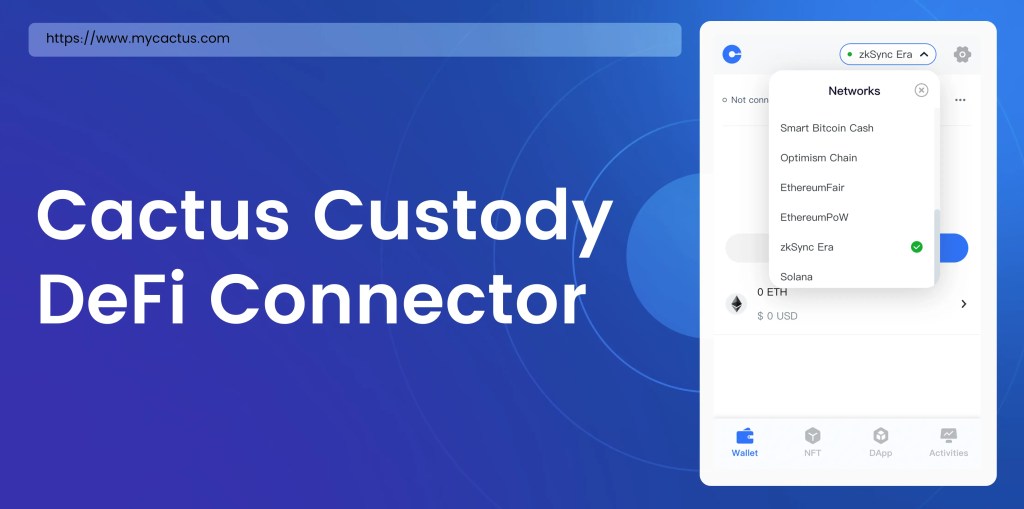
Cactus Custody now proudly offers support for zkSync Era via the Cactus CustodyDeFi connector and Metamask Institutional Solution. We take pride in providing our users with smooth and highly secure DeFi connectivity, granting our users peace of mind as they navigate both EVM-compatible and non-EVM chains.
Feel at ease while exploring Cactus Custody’s state-of-the-art services, tailored to ensure the security of your DeFi journey.
- Mainnet refers to a fully developed and active blockchain where cryptocurrency transactions are broadcasted, verified, and recorded on a distributed ledger. In contrast, a testnet is a pre-launch version of a blockchain network used by developers to test and troubleshoot features before the mainnet launch. ↩︎
- Transactions happening outside a given blockchain network, which could be grouped and sent to the main chain later on. ↩︎